
Medical Device 3D Printing:
Non-Implant Medical Devices & Precision Plastic Enclosures
Precision-Engineered. Biocompatible. Certified Reliability.
Executive Overview
Healthcare hardware, point-of-care diagnostic tools, and clinical instruments require ultra-durable, ergonomically refined, and sterilizable outer enclosures. From handheld vital sign monitors to patient-matched non-implant surgical guides, medical devices must protect sensitive internal electronics, PCBs, and sensors while enduring daily hospital handling and aggressive chemical wipe-downs.
At HIGH On 3D, we specialize in non-implantable medical device manufacturing using industrial powder-bed fusion (HP MJF, SLS), high-resolution SLA 3D printing, complementary micro-CNC machining, and short-run vacuum casting. From single proof-of-concept verification units to full serial production runs, we support medical OEMs, hospitals, and research labs with tightly documented tolerances, sterilizable materials, and clinical-grade surface finishes.
Why Leading Healthcare OEMs Choose Additive Manufacturing
- Tooling-Free Rapid Iteration:Transition from CAD to functional medical components in hours. Verify PCB alignments, display windows, snap-fit battery doors, and light pipe integrations without committing to expensive steel tooling.
- Clinical-Use Design Optimization:Build lightweight, ergonomically optimized devices featuring organic internal channels and lattice structures for airflow, cable routing, or fluid paths.
- Disinfectant & Sterilization Resistance:Access high-performance polymers (UL94-V0 flame retardant, medical ABS, Polycarbonate, Nylon PA12) compatible with isopropyl alcohol (IPA), bleach sanitization, or EtO/steam autoclave protocols.
- Part Consolidation:Merge multi-piece medical assemblies into single monolithic builds to eliminate potential gasket failure points, reduce assembly steps, and simplify inventory management.
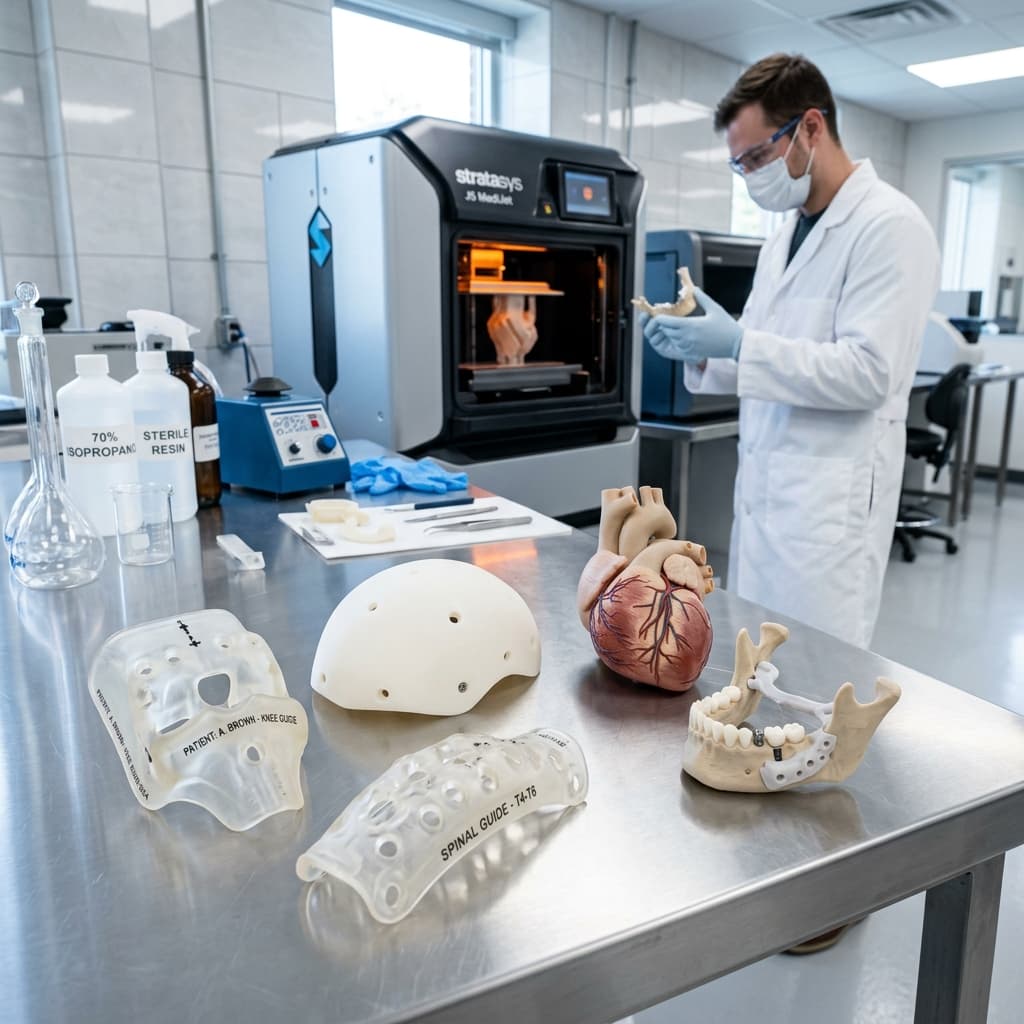
- Patient-Specific Customization:Convert patient DICOM scan data (CT/MRI) directly into 1:1 scale anatomical visual models and patient-matched surgical cutting guides for pre-operative planning.